
I want to be a person who is pleasing to look at, not merely tolerated. When God looks at me, does He see someone pleasing to Him? I imagine a version of myself walking in holiness and purity; someone of whom the Father would say, “Look at my son. See how what he is doing is pleasing to me. I can smell the fragrance coming from his life.”
Yet I have often found myself falling short of the person I long to be. I have broken my own standards, let alone God’s standards, which my carnal mind cannot fully grasp. Maybe you are on a similar journey. You do something and think, I know I am His child, but I am not pleasing my Father or making Him proud because of what I’ve been doing.
The Holy Spirit led me to study the burnt offering, the offering described in Scripture as a pleasing aroma to God. In Leviticus chapter 1, the Lord, who brought Israel out of Egypt, gives instructions for the burnt offering.
The book of Leviticus opens with descriptions of five offerings used in Old Covenant worship: the burnt offering, the grain offering, the peace offering, the sin offering, and the guilt offering. Three of these offerings deal specifically with sin and its effects. They reveal how sin affects the worshiper, the place of worship, and the community.
In the New Testament, Jesus fulfills these sin-sacrifices, revealing the different facets of His redemptive work on our behalf.
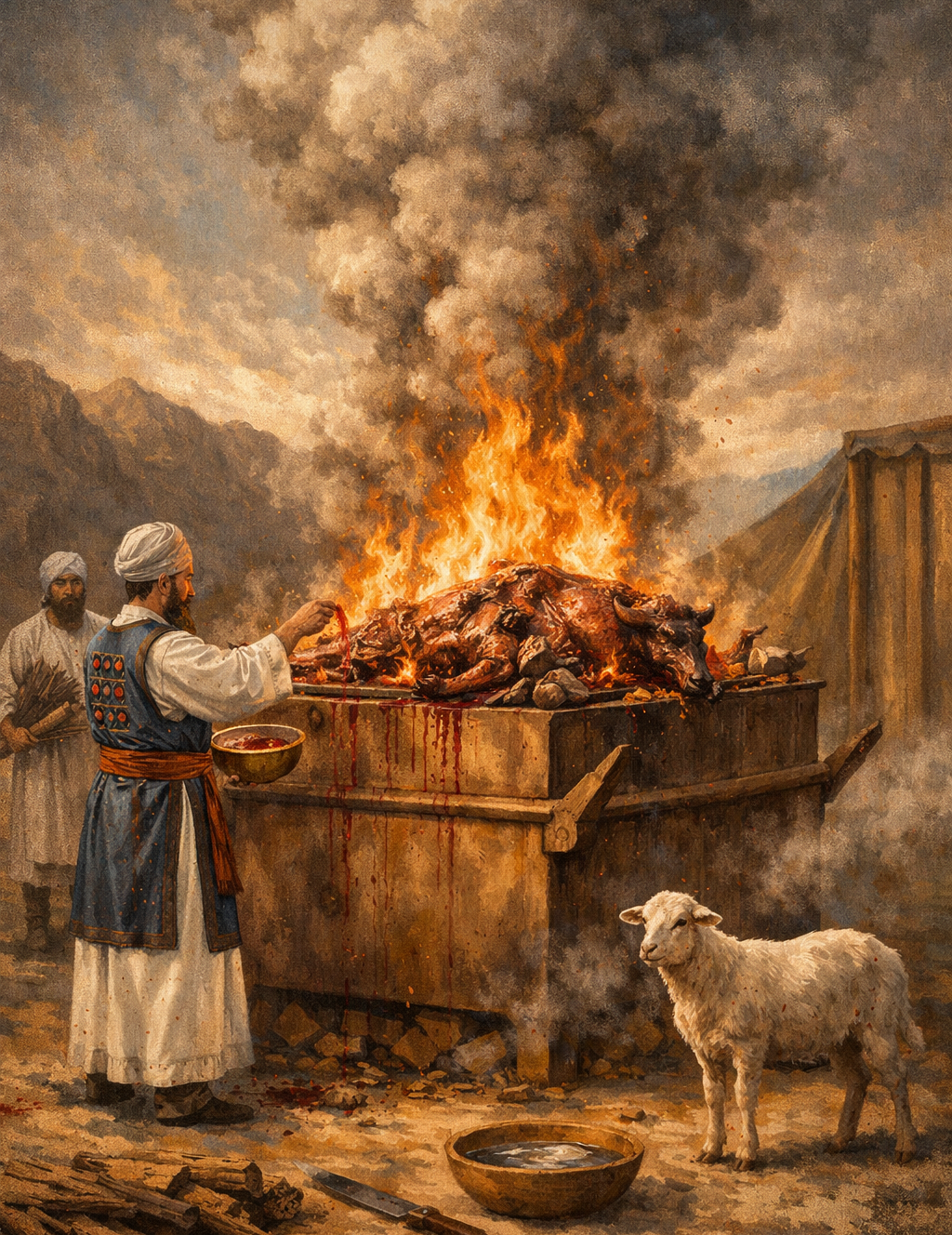
The burnt offering is the first offering described in Leviticus. What makes it unique is that the entire animal (except the skin) is burned on the bronze altar as a sweet-smelling aroma to God. The worshiper identifies with the animal by laying hands on it, slaughters it, and symbolically ascends to God through the smoke of the sacrifice. This act represents reconciliation and peace between God and the worshiper.
(Adapted from a Core Christianity article on the burnt offering.)
Laws for the Burnt Offering
- A male without blemish
- Brought to the entrance of the Tent of Meeting
- The worshiper lays his hand on the head of the offering
“And it shall be accepted for him to make atonement for him.” - The bull is killed before the Lord
- The priests throw the blood against the sides of the altar
- The offering is flayed and cut into pieces
- Fire and wood are arranged on the altar
- The entrails and legs are washed with water
- Everything is burned on the altar
“A food offering with a pleasing aroma to the Lord.”
Scripture later tells us:
“And walk in love, as Christ loved us and gave Himself up for us, a fragrant offering and sacrifice to God.” — Ephesians 5:2
“But with the precious blood of Christ, like that of a lamb without blemish or spot.” — 1 Peter 1:19
As I read this, a question rises in my heart: Why such a horrific death for an innocent animal? What did it do to deserve this?
Then I think about the moment when God said, “This is my beloved Son, in whom I am well pleased.”
Did He say this because He knew His Son would become the burnt offering, the One without blemish, fully pleasing to God? The One who willingly gave Himself as a sacrifice because He loved us?
Have you ever looked at yourself with disgust? Have you ever heard someone say, “I love you, but for me to truly like you, you need to change something”?
That is the opposite of the gospel.
The gospel is this: He who was without blemish gave Himself for us because He loved us. And now, in Him, we are the fragrance of God, a pleasing sacrifice.
So when God looks at us and speaks over us, He does not say it reluctantly. He says,
“This is my beloved son.”
“This is my beloved daughter.”
“In them, I am well pleased.”
It is God who justifies. So when an accusing voice rises within you, condemning you for your failures, answer it boldly:
“Look at my Savior’s life. He is the perfect Son of God. He died on my behalf, so that I could be pleasing to my God.”
He loves you, and He likes you. You cannot give Him a bad day. Because of the sacrifice, He is not merely tolerating you; He delights in you. So live boldly and guilt-free.